
Boot & Blade Combinations
Choosing the right boot and blade separately is only half the equation. How they work together determines your overall skating experience. A well-matched combination ensures your equipment supports your current skill level and gives you room to grow.
Why Pairing Matters
Before You Start: Are You Pairing At All?
If you are at the recreational or early freestyle end, you may not need to pair anything — complete skates arrive with a matched blade already mounted and sharpened, and they cost less than the cheapest boot-and-blade build. See Complete Skates vs. Boot and Blade Separately. Everything below is for skaters buying the two pieces separately.
Recommended Combinations by Level
Two routes at each level — one built on an EDEA boot, one on a Jackson. Jackson is the only brand here that makes both halves, so a Jackson setup can come from a single maker if you prefer.
| Level | EDEA setup | Jackson setup |
|---|---|---|
|
Beginner Singles through Axel |
Overture + MK Galaxy or MK Professional | Debut + Ultima Legacy 7 or Mirage |
| First double jumps | Chorus + MK Professional or JW Coronation Ace | Premiere + Ultima Legacy 8 or Aspire X |
|
Intermediate Double jumps |
Chorus + MK Professional or JW Coronation Ace | Supreme or Synergy Ignite + Apex Freestyle |
|
Advanced Triple jumps |
Concerto or Ice Fly + MK Phantom, Gold Star or JW Gold Seal | Supreme or Synergy Torch + Apex Supreme or Matrix Supreme |
|
Elite Triples & quads |
Piano + Gold Star REV, Pattern 99 REV or Phoenix 99 | Supreme 95 or Synergy Torch + Apex Elite or Matrix Elite |
| Ice Dance | Flamenco Ice + MK Dance | Supreme Low Cut + Apex Dance |
| Synchro | Any freestyle boot at your level | Low Cut Debut + Apex Synchro |
Beginner: Structured Boot, Stable Blade

The Overture provides structured support for beginning freestylers, and the MK Galaxy is the natural entry-level match with its stable parallel profile. Skaters progressing quickly may start with the MK Professional, which carries them further before an upgrade.
On the Jackson side, the Debut pairs with the Ultima Legacy 7. Its Cross Cut pick pattern has the highest lift angle of Jackson's three families, which is genuinely forgiving if you tend to catch your toe pick too early — a common beginner problem that is as much geometry as technique.
First Doubles: Stepping Up
The Axel is still Overture territory — EDEA rates that boot for single jumps through the Axel, so landing it is not on its own a reason to upgrade. Starting doubles is.
At that point the two ranges are shaped differently. EDEA covers it with the Chorus at 75, a boot that takes you from your first doubles through to consistent doubles — you grow into it. Jackson splits the same ground into two finer steps, the Synergy Spark (60) and Premiere (65–69), so you can match support more precisely to where you are now.
Which suits you depends on how fast you are progressing and how much boot you want to grow into. Either way, the Ultima Legacy 8 is a strong blade at this stage — it exists because coaches asked for a true intermediate blade, and supports all double jumps and flying spins without the cost of a competition blade.
Intermediate: Handling Double-Jump Impact
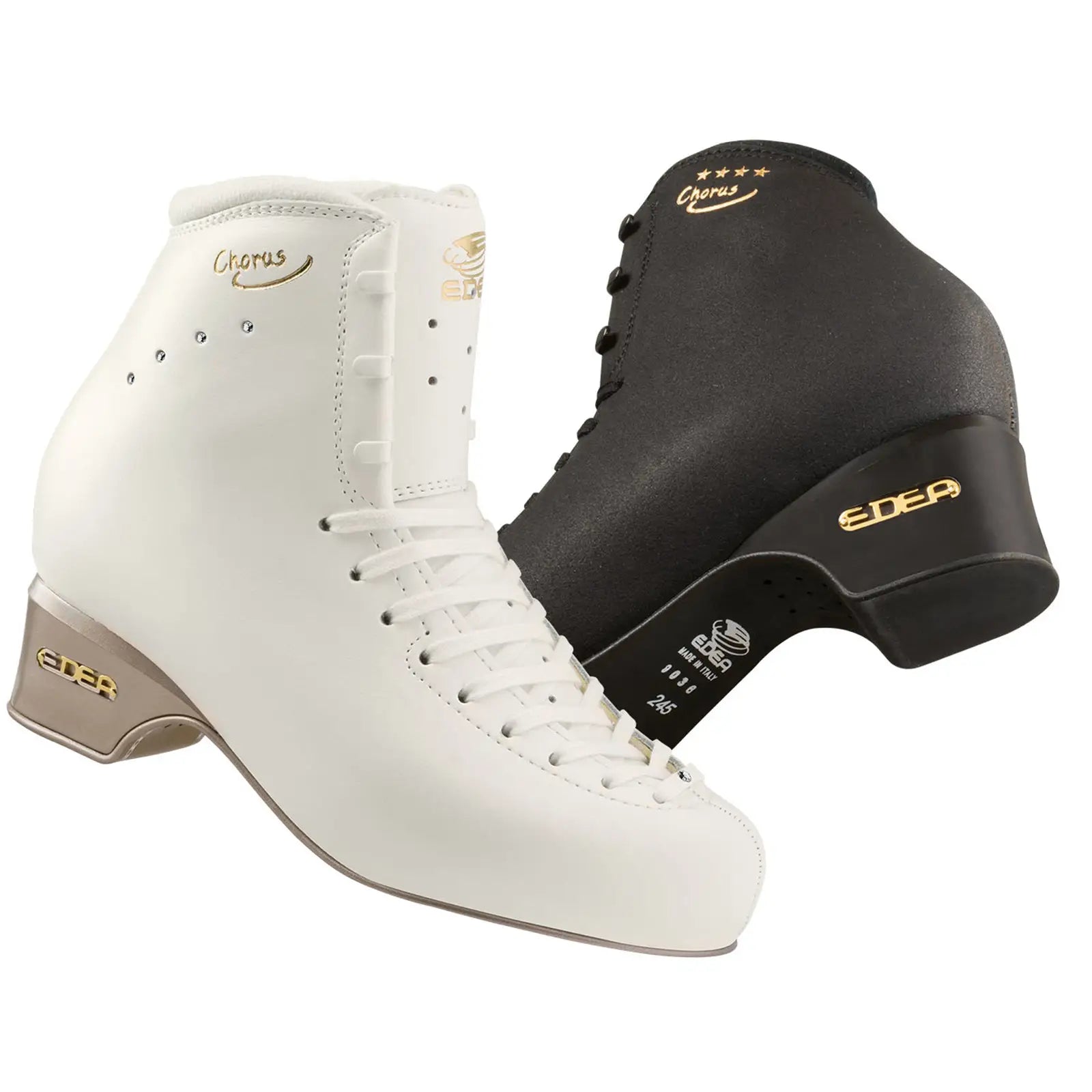
The Chorus handles double-jump impact while its soft collar preserves ankle mobility. The MK Professional and Coronation Ace are both proven intermediate parallel blades with 7-foot rockers — the Coronation Ace is the most popular freestyle blade in the world.
Jackson's Supreme at 75 is the equivalent step, with the Apex Freestyle bringing a titanium-coated runner that holds an edge longer between sharpenings.
Advanced: Where Blade Geometry Starts to Matter

The Phantom and Gold Star are both tapered, side-honed, 7-foot rocker blades, but the Gold Star's complex secondary radius gives superior spin performance. The Gold Seal offers an 8-foot rocker with high stanchions for deeper edges. The Concerto gives a classic leather look; the lighter Technomicro Ice Fly provides a weight advantage that matters in the air.
Jackson's Apex Supreme and Matrix Supreme split the same way: Apex for edge life, Matrix for weight — its aluminium chassis comes in 33% lighter than a forged blade.
Elite: Every Gram Counts

The Piano is the only EDEA boot with the integrated Anti-Shock system, designed for competitive triple and quad landings. Pairing it with a REV or Phoenix blade maximises weight savings — the Phoenix 99 and Phoenix Gold are the lightest options at 46% below traditional blade weight.
Jackson's answer is the Supreme at 95 or Synergy Torch with a Matrix Elite. Worth knowing: the Matrix RXS versions let you replace a worn runner rather than the whole blade, which no MK or John Wilson model does.
Ice Dance and Synchro

The Flamenco Ice's low-cut padded cuff allows graceful toe points and extreme ankle articulation, while the MK Dance's slimline profile enables the rapid edge transitions dancers need. At the 2018 Olympics, 85% of ice dance competitors skated on the MK Dance.
Jackson's Low Cut boots use a u-shaped cuff that clears the Achilles entirely for the same reason, paired with the Apex Dance — a 7-foot rocker with short heels.
A Note on Upgrading
Mixing brands is fine, too — a Jackson blade mounts to an EDEA boot and vice versa. What changes is the mounting hardware, because the soles differ; see Blade Mounting & Screws.
For help choosing equipment individually, see our boot choosing guide and blade choosing guide. For sizing, visit the Boot Sizing Guide and Blade Sizing Guide.
Need Help?
Choosing the right equipment can feel overwhelming, but you don't have to figure it out alone. We're real skaters helping real skaters — no pressure, just honest guidance.
Contact Us