
Understanding Boot Support & Stiffness Ratings
Stiffness is the single most important specification on a figure skating boot. It determines how much support the boot provides, how much impact it absorbs, and how much ankle mobility it allows. Both brands we carry publish a number for it — EDEA calls it stiffness, Jackson calls it a Support Rating — but the two scales are built differently and cannot be compared directly. This guide explains what each number means and how to match either one to your skating.
What Stiffness Means Physically
Stiffness describes how much force is required to flex the boot at the ankle. A stiffer boot resists bending more, providing greater lateral support and absorbing more impact energy from jump landings. A softer boot flexes more easily, allowing greater ankle range of motion but offering less protection under high forces.
When you land a jump, the impact force can reach 2 to 8 times your body weight. The boot's stiffness prevents your ankle from collapsing under that force. A boot too soft for your jumps will bend past its structural limit and wear out rapidly. A boot too stiff for your level requires excessive effort to flex, slowing your progress and causing fatigue.
Two Brands, Two Scales
Both EDEA and Jackson rate their boots on a numbered scale that tops out at 95, and both measure the same physical property. That is where the similarity ends. The scales are calibrated against different ranges of skater, so the same number means a different boot depending on the brand.
The reason is range. EDEA builds freestyle boots and starts its scale at 40. Jackson builds everything from learn-to-skate rentals to elite competition boots, so it needs a scale that stretches much further down. Both converge at the top: an EDEA 95 and a Jackson 95 are each built for triples and quads.
The EDEA Stiffness Scale
| Boot Model | Stiffness | Level | Jumps Supported | Shell Material |
|---|---|---|---|---|
| EDEA Wave | 40 | Absolute Beginner | First time on ice | 3D Technomicro |
| EDEA Motivo | 45 | Progressing Beginner | Learning to jump and spin | Waterproof Leather |
| EDEA Overture | 55 | Beginner Freestyle | Single Jumps through Axel | Waterproof Leather |
| EDEA Chorus | 75 | Intermediate | Double Jumps | Waterproof Leather |
| EDEA Concerto | 85 | Advanced | Triple and Quad Jumps | Coated Leather |
| EDEA Flamenco Ice | 85 | Dance (Intermediate to Senior) | Dance Lifts / Twizzles | Waterproof Leather |
| EDEA Ice Fly | 90 | Advanced / Elite | Triple and Quad Jumps | Technomicro |
| EDEA Piano | 95 | Elite / Competitive | Triple and Quad Jumps | Technomicro + Anti-Shock |
The Jackson Support Rating Scale
Jackson groups its ratings into named tiers. Because Jackson sells complete skates at the recreational end and boot-only models further up, the table below shows how each family is sold as well as how it rates.
| Model Family | Support Rating | Tier | Jumps Supported | Sold As |
|---|---|---|---|---|
| Jackson Excel | 2–5 | Light | None — first lessons | Complete skate |
| Jackson Softec & SoftSkate | ~10 | Light | None — recreational skating | Complete skate |
| Jackson Mystique | 10–19 | Light | None — learn to skate | Complete skate |
| Jackson Artiste & Evo | 20–25 | Light | Basic skills, half jumps | Complete skate |
| Jackson Elle | 30–35 | Moderate | Half-rotation jumps, spins | Complete skate |
| Jackson Flex | 30–35 | Moderate | Single-rotation jumps | Boot only |
| Jackson Entré | 35–40 | Moderate | Developing single jumps | Boot only |
| Jackson Freestyle | 40–49 | Moderate | Single-rotation jumps | Complete skate |
| Jackson Debut | 45–55 | Moderate to Firm | Singles through the Axel | Boot only |
| Jackson Synergy Spark | 60 | Firm | First double jumps | Boot only |
| Jackson Premiere | 65–69 | Firm | First double jumps | Boot only |
| Jackson Supreme | 65–95 | Strong to Ultimate | Doubles through triples and quads | Boot only |
| Jackson Synergy Ignite | 75–85 | Strong to Premium | Doubles into triples | Boot only |
| Jackson Synergy Torch | 85–95 | Premium to Ultimate | Triples and quads | Boot only |
Matching the Two Scales
Because the numbers do not translate, the only honest way to compare the brands is by what you are actually skating. Find your row, then read across.
| What you're skating | EDEA | Jackson |
|---|---|---|
| First time on ice, no jumps | Wave (40) | Excel (2–5), Softec (~10), Mystique (10–19) |
| Basic skills and half jumps | Motivo (45) | Artiste / Evo (20–25), Elle (30–35) |
| Single jumps through the Axel | Overture (55) | Flex (30–35), Entré (35–40), Freestyle (40–49), Debut (45–55) |
| First double jumps | Chorus (75) | Synergy Spark (60), Premiere (65–69) |
| Double jumps | Chorus (75) | Supreme (65–75), Synergy Ignite (75) |
| Triple jumps | Concerto (85), Ice Fly (90) | Supreme (85), Synergy Ignite (85), Synergy Torch (85) |
| Triples and quads | Piano (95) | Supreme (95), Synergy Torch (95) |
| Ice dance | Flamenco Ice (85) | Low Cut Debut (45), Supreme Low Cut (85) |
| Show skating | Showgirl | — no Jackson model in this band — |
Notice that the Chorus appears in two rows. That is deliberate — at 75 it carries a skater from their first doubles right through consistent doubles, so one boot covers a stage where Jackson offers two finer steps in the Synergy Spark (60) and Premiere (65–69). Neither approach is better: EDEA asks you to grow into one boot, Jackson lets you match your support more precisely as you progress.
The Axel itself sits with the Overture, which EDEA rates for single jumps through the Axel. Move up when you start working doubles, not when you land the Axel.
One genuine gap is worth naming: Jackson makes no dedicated show-skating boot, where EDEA has the Showgirl.
See the EDEA Range

Wave — Stiffness 40

Motivo — Stiffness 45

Overture — 55
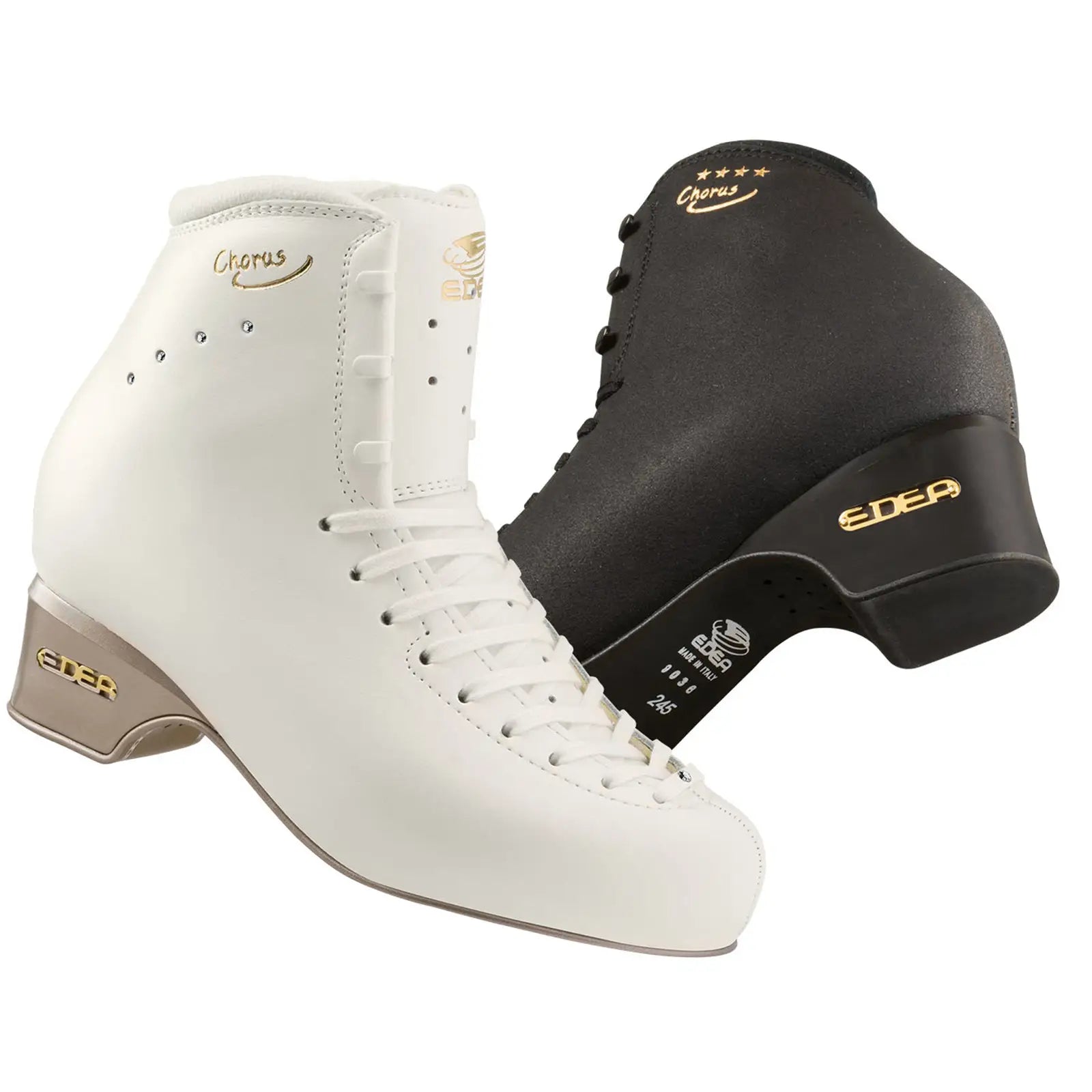
Chorus — 75

Concerto — 85

Flamenco Ice — 85

Ice Fly — 90

Piano — 95
See the Jackson Range

Excel — Support 2–5

Mystique — Support 10–19

Elle — Support 30–35

Freestyle — Support 40–49

Debut — Support 45–55

Premiere — Support 65–69

Supreme — Support 65–95

Synergy Torch — Support 85–95
How to Pick Based on Weight, Skill, and Jump Level
Whichever brand you are looking at, the choice depends on three factors:
- Skill Level and Jump Type: The primary factor. The jumps you are currently performing and those you will work on in the next 6 to 12 months determine the minimum support you need.
- Body Weight: Heavier skaters generate more landing force and may need to go one level stiffer. A 140-pound skater working doubles may thrive in the Chorus at 75 or a Supreme at 75; a 180-pound skater at the same level might benefit from the Concerto at 85 or a Supreme at 85.
- Training Intensity: Skaters who train many hours per week break down boots faster and may benefit from a slightly stiffer boot that maintains support longer.
What Happens If You Pick Wrong
| Problem | Too Stiff | Too Soft |
|---|---|---|
| Ankle mobility | Restricted — poor knee bend | Excessive — ankle collapses inward |
| Jump performance | Difficult takeoffs, excess fatigue | Unsafe landings, no impact absorption |
| Boot longevity | Outlasts the skater's patience | Breaks down rapidly |
| Injury risk | Compensatory bad habits form | Increased ankle injury risk |
When to Move Up in Support
Consider moving to a stiffer boot when:
- You are consistently landing the highest jump level your current boot supports and are ready to progress.
- Your current boots show visible ankle collapse on landings.
- Your coach recommends increased support based on your progression.
Not sure where to start? Our Find Your Skate guide walks you through it in three questions. For help choosing a specific model, see our How to Choose Figure Skating Boots guide. For recommended pairings at each level, visit Boot and Blade Combinations.
Need Help?
Choosing the right equipment can feel overwhelming, but you don't have to figure it out alone. We're real skaters helping real skaters — no pressure, just honest guidance.
Contact Us